Weekly Market Update: Markets Rebound, But Inflation and Global Tensions Keep Investors on Edge - April 6, 2026
Weekly Market Update | April 6, 2026
Markets Rebound, But Inflation and Global Tensions Keep Investors on Edge
Markets gave investors a much-needed rebound last week, but beneath the surface, volatility and uncertainty remain.
After a period of heightened geopolitical tension in the Middle East, equity markets moved higher as investors began pricing in the possibility of de-escalation. At the same time, economic data continues to reflect a mixed—but still resilient—environment.
What Happened Last Week
U.S. equity markets finished higher despite a volatile, headline-driven environment. A late-week rally helped lift major indices off their lows, supported in part by easing concerns around oil supply disruptions and improving sentiment.¹
Economic data also provided some support:
Nonfarm payrolls increased by 178,000, significantly above expectations, suggesting the labor market remains stable.¹³
Retail sales rose 0.6%, reinforcing that consumer spending continues to be a key driver of economic growth.¹⁴
Broader market performance reflected this resilience, with the S&P 500 posting a weekly gain of over 3%.¹
At the same time, geopolitical developments—particularly involving Iran and global oil supply—continued to influence market behavior and investor sentiment.²
Why This Week Matters
Looking ahead, markets are now focused on inflation and interest rate expectations.
Key economic reports this week—including the Consumer Price Index (CPI) and Personal Consumption Expenditures (PCE)—will provide insight into whether inflation is stabilizing or remaining elevated.²
These data points are critical because they directly influence Federal Reserve policy decisions. If inflation remains higher than expected, markets may need to adjust to a longer period of restrictive monetary policy.
What We’re Watching
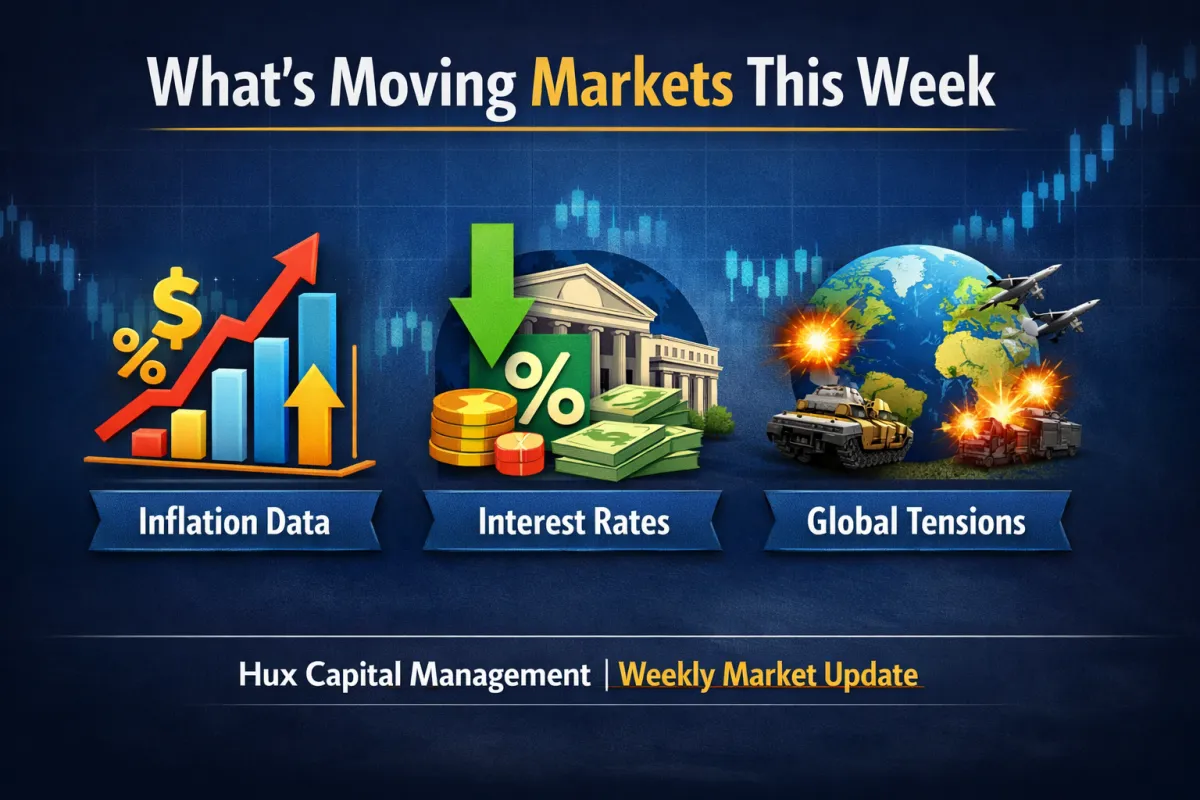
There are three primary drivers markets are reacting to right now:
1. Inflation Data
Inflation remains one of the most important variables for both equity and fixed income markets. Even modest surprises can shift expectations quickly.
2. Interest Rates
Treasury yields have remained volatile as investors reassess the timing and pace of potential policy changes.²
3. Geopolitical Risk
Ongoing tensions in the Middle East continue to impact oil prices and global market sentiment, adding another layer of uncertainty.²
What This Means for You
While short-term market movements can feel unsettling, this type of environment is not unusual.
Markets are constantly adjusting to new information—economic data, policy expectations, and global events. What matters most is having a disciplined investment strategy designed to navigate these periods.
At Hux Capital Management, our focus is on:
Building portfolios based on data and long-term principles
Helping you understand what’s happening in the markets
Making thoughtful adjustments when necessary—not emotional reactions
If you have questions about how current conditions may impact your plan, we’re here to help you think through it.
Book a meeting with our team, and let’s make sure you’re positioned with clarity and confidence.

Sources:
Data and commentary referenced in this article are derived from the following sources:
¹ Simplicity Wealth Weekly Commentary, April 6, 2026
² Charles Schwab Macro Monday Report, April 6–10, 2026
³ U.S. Bureau of Labor Statistics (Nonfarm Payrolls)
⁴ U.S. Census Bureau (Retail Sales Data)
Disclosures:
Investment advisory and financial planning services are offered through Simplicity Wealth, LLC, an SEC Registered Investment Adviser. Registration does not imply a certain level of skill or training. Insurance, consulting, and education services are offered through Hux Capital Management, which is a separate and unaffiliated entity from Simplicity Wealth.
This content is for informational purposes only and should not be construed as investment, tax, or legal advice. The information provided is believed to be accurate at the time of publication but is not guaranteed. Past performance is not indicative of future results. All investments involve risk, including the potential loss of principal.
The source(s) used to prepare this material is/are believed to be true, accurate and reliable, but is/are not guaranteed. This report discusses specific sectors, including Energy, Utilities, and Consumer Staples. Investing in specific sectors may involve greater risk and volatility than a more diversified investment approach. Past performance is not indicative of nor does it guarantee future performance.
